
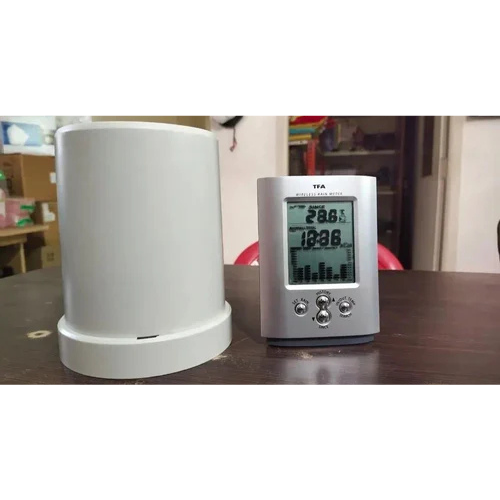
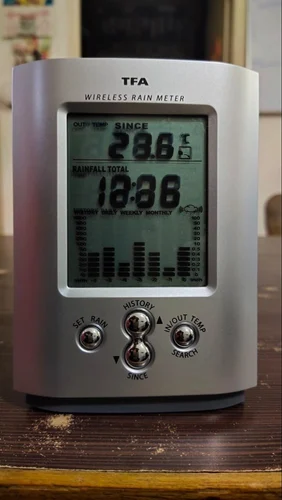
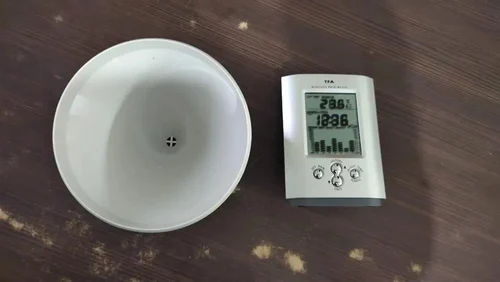
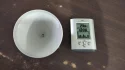
Wireless Rain Gauge
₹19,500
Product Code :
| Rain Gauge Type | Tipping Bucket |
|---|---|
| Recording Type | Self Recording |
| Operation Type | Manual |
| Collecting Area | 200 cm2 |
| Brand | Davis |
| Temperature Range | 0-70 degree c |
| Accuracy | 2 % |
| Power Supply | Solar Power V |
| Type Of Data Logger | DIGITAL |
| Material | PLASTIC |
| Is It Portable | Portable |
| Usage/Application | TO OBSERVE RAIN |
| I Deal In | New Only |
| Brand | TFA & OREGON |
| Model Name/Number | DIGITAL WIRELESS RAIN GAUGE |
| Availability | In Stock |
Digital rain gauges contain a rain sensor that allows for collection and analysis of precipitation data. These gauges consist of a self-emptying rain collector that transmits rain data wirelessly up to 330 feet away to an LCD display, which you can read from the comfort of your home.
How does a digital rain gauge work? A digital rain gauge or rain sensor measures rain through a tipping bucket sensor. This is a little spoon-shaped cup that tips over when a certain weight is being exceeded. Every time the 'spoon' is emptied
The correct answer is Total internal reflection. Automatic rainfall sensor works on the principle of Total internal reflection
The standard rain gauges working principle is to collect falling rainwater in a funnel-shaped collector connected to a measuring tube. The diameter of the collector is 10 times the diameter of the tube. Therefore, the working principle of the rainfall gauge is to magnify the liquid by 10 times
A standard rain gauge has a graduated cylinder, or a cylinder with measurement marks on the side and a funnel on top. When rain falls, it goes into the funnel and collects in the graduated cylinder. Many rain gauges have two cylinders: a smaller cylinder inside of a larger cylinder.
There are three components in the rain gauge: a funnel, a measuring tube, a 4-inch diameter overflow tube, and a mounting bracket. The funnel directs and magnifies the precipitation by a factor of 10 into the measuring tube
1cm (10mm) of rainfall will collect 3.14/4 x D2 cm3 (or ml) = 0.785D2 ml of water in the bucket. Therefore 1mm of rainfall will collect 0.0785 D2 ml of water where D is the diameter of the bucket in cm.
Customer Reviews
No reviews yet.